Houdini, Karma; 2025
Final Work
Work Description
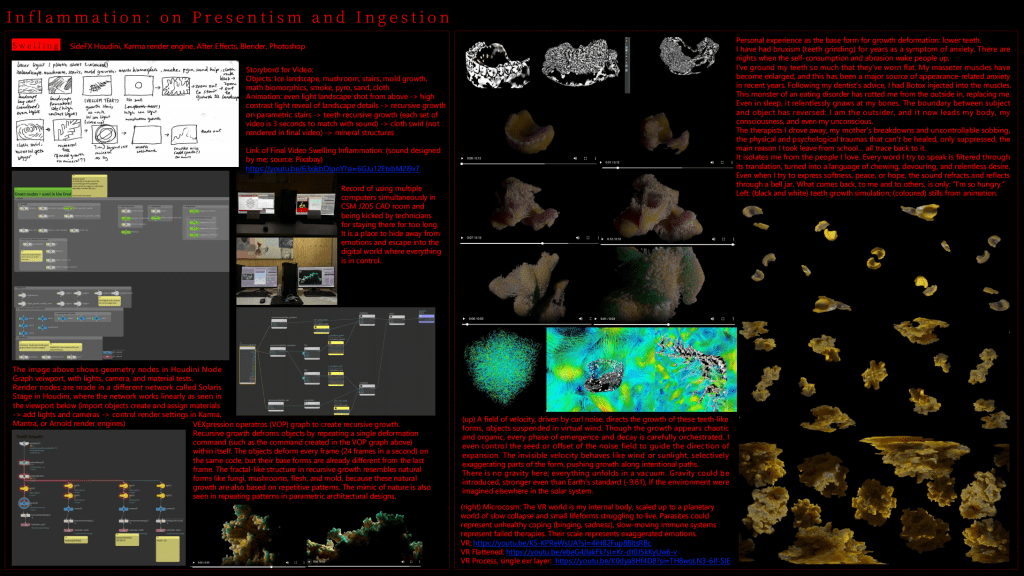
Set in a glacial, quiet terrain, microscopic ruptures agitate beneath the surface. Scattered cells on math formulas and recursive growths resemble memory’s distorted echoes.
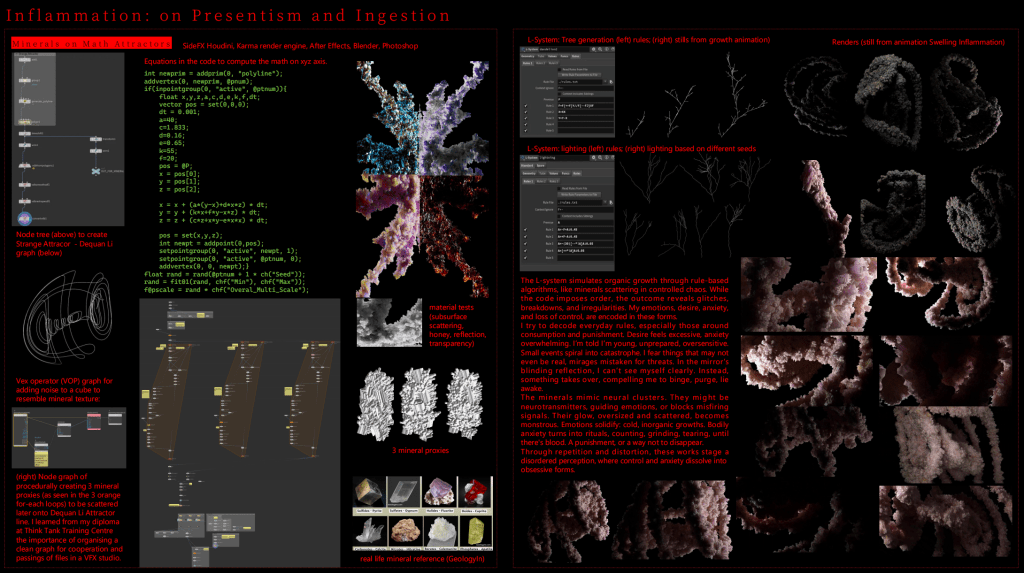
Built in Houdini, the deformed objects generate mineral and biomorphic patterns that are symbiotic presences. The growth and decay are both biological and symbolic, a machinic mimicry of remembrance.
The VR space becomes a claustrophobic internal landscape that shrinks. The audience becomes a microbial spirit navigating the overscaled world, where every surface contains intimate chaos.
Referencing the myth of Narcissus, the work becomes a digital mirror where the viewer is both subject and symptom, immersed in a world of slow collapse, soft invasions, and quiet saturation.
There is no clean boundary between inner and outer. Materials glitch and erode into each other, as if the environment itself is metabolizing memory. The world refuses hierarchy; it is post-medium, post-object, and post-therapeutic.
Process
Landscape
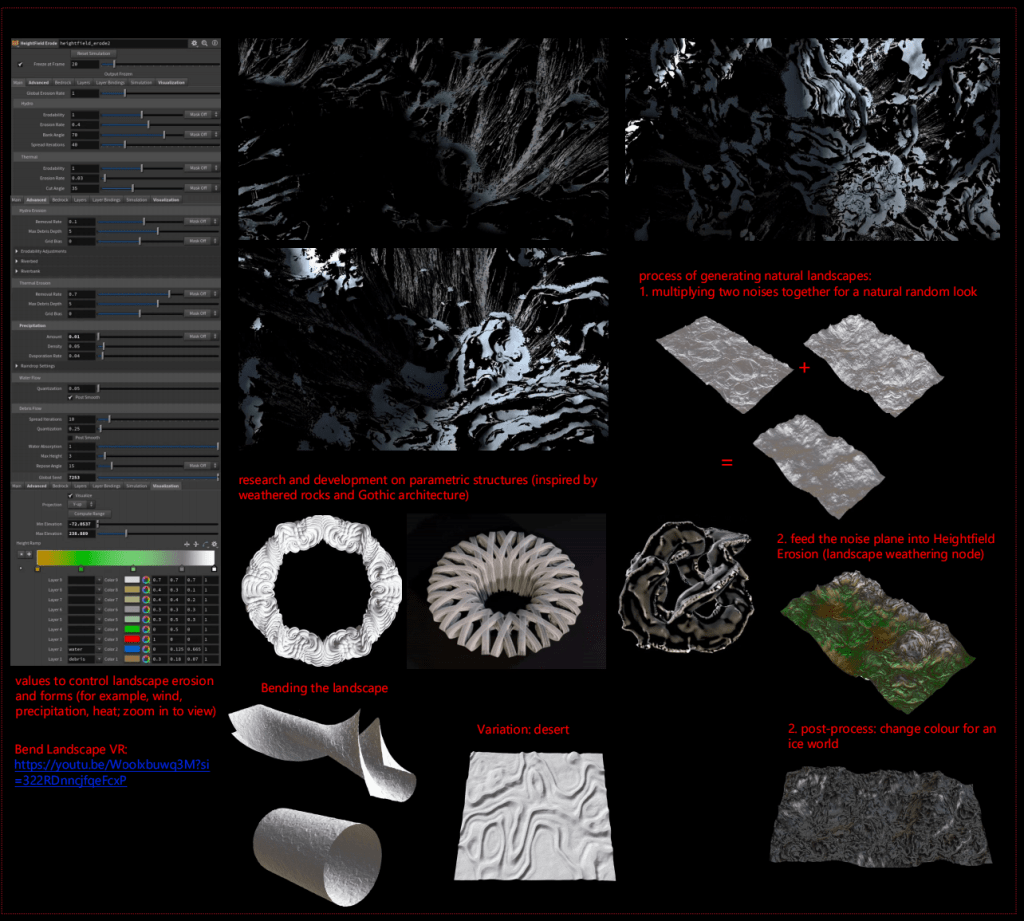
Concept and FX
Artist Statement
My recent practice explores the intersections of digital simulation, psychoanalysis, and ecological aesthetics. Working with procedural animation tools such as Houdini, I create visual systems that reflect ecological entanglement, symbolic logic, and the recursive nature of trauma. Influenced by psychoanalytic concepts, such as Freud’s uncanny and death drive, Kristeva’s abjection, and Lacan’s symbolic order, I visualise psychological and emotional experiences as evolving systems composed of spores, parasites, mineral formations, and morphing organic structures. These simulations echo bodily symptoms and social undercurrents that are hard to describe in language, but become visible through metaphorical visuals.
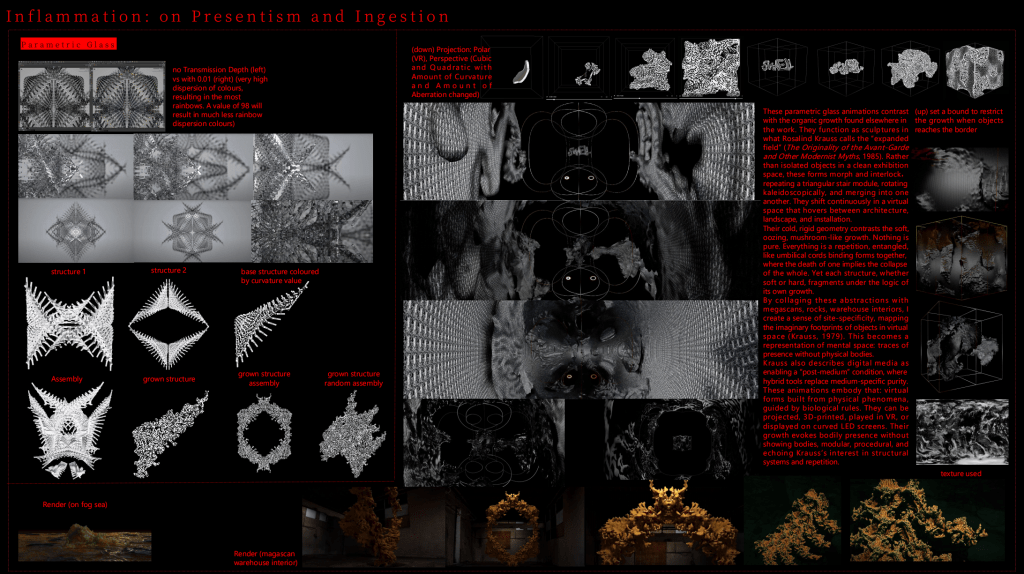
My work is situated in a world of ecological instability and symbolic fragmentation. Drawing from Rosalind Krauss (1979)’s post-medium theory, I approach form and material as fluid, allowing my work to exist across screens, spatial installations, and potential interactive environments. Hal Foster (1996) ’s writing on trauma and the return of the real shapes my understanding of repetition and symbolic fragmentation in contemporary art. In this context, trauma does not heal, but loops, its remains floating in visual and sonic glitches, incomplete growth cycles, or morphing, unresolved forms.
Informed by these theories, I reinterpret Freud’s case of the Wolf Man into an animation of flashing tree branches, growing teeth, and blurry wolves. Rather than narrativising trauma directly, I create atmospheric environments that evoke discomfort and ambivalence. The growth of teeth and fungal spores reflects Kristeva’s concept of abjection (matter that is both self and other, internal and expelled).
These elements repeat in unfamiliar and strangely intimate landscapes, representing anxiety as something both intrinsic and estranged. The boundary between self and world becomes porous.
Technically, I work with growth simulations, Volumetric Data Blocks and Surface Operators solvers, recursive noise functions, and data visualisation. These tools enbable me to build systems that replicate organic forms, like soft fungal rhizomes or inflammation, but they are generated through exact mathematical rules. Thus, the digital mimics biological processes in a synthetic way, reflecting the tension between structure and fracture. I use unusual lens perspectives (such as polar or perspective distortions) and integrate real-world datasets like Megascans or Strange Attractor equations to build immersive scenes that are based on the physical while remaining speculative and hallucinatory.
My practice is increasingly collaborative. I’ve contributed digital garments to a fashion photography graduation project that explores emotions in movements and motion capture. I’m also developing works that move between 2D and 3D, allowing my forms to extend into virtual experiences, interactive spaces, and immersive worlds. This opens up possibilities for audience interaction, particularly through game engines or audiovisual installations.
Ultimately, my work seeks to visualise psychological states and social norms through virtual imaginations. Instead of fixed interpretations, I create environments that shift, swell, and morph, inviting viewers into unstable terrains where they can let their own narratives flow above the conscious surface within mine. Through symbolic forms and ecological logic, I research on the limits of subjectivity, the different forms of trauma, and the recursion of desire.
 Siyun Sun